Most healthcare ads are speaking to a patient who is ready to take action.
The problem? Most of their patients aren’t there yet.
Your clinic’s marketing may be generating traffic. It may even be generating leads. But if those leads aren’t booking — if people click and then disappear — the problem is almost never your budget. It’s the gap between what your ad says and what your patient is psychologically ready to hear.
Healthcare marketing has a trust problem, not a traffic problem.
Most clinics are spending money to reach people who are already anxious, already skeptical, and already mid-decision — and then greeting them with aspirational copy that speaks to a calmer, more motivated version of themselves that doesn’t exist yet at that moment.
Behavioral marketing fixes this — not by being louder, but by being accurate. When your messaging reflects what your patient is actually thinking and feeling, it stops feeling like advertising and starts feeling like understanding. That shift is what drives bookings.
The Behavioral Marketing Playbook for Healthcare & Wellness Brands covers the five behavioral levers that drive healthcare decisions, why standard analytics can’t show you what’s really happening, and how to apply all of it across your actual marketing stack.
What Makes Healthcare Marketing Uniquely Difficult
The trust deficit that other industries don’t have
Healthcare is the only industry where the buyer is simultaneously a patient — meaning their cognitive state at the moment of purchase is fundamentally different from any other category. Fear, shame, denial, and hope are all present at once. Most marketing frameworks are designed for rational buyers who are evaluating options with reasonable composure. Healthcare buyers are rarely rational at the moment of decision.
Asking someone in the middle of a health crisis to ‘start their wellness journey’ is like handing a drowning person a brochure about swimming lessons.
The offer may be excellent. The timing and language are completely wrong.
Standard digital marketing frameworks — AIDA funnels, lead generation forms, click-through optimisation — were built for considered, low-anxiety purchases. Healthcare decisions are high-anxiety, high-stakes, and emotionally loaded. Applying a standard framework to this context is why most healthcare ads underperform despite reasonable budgets and decent creative.
Three behavioral realities every healthcare marketer must accept
Before applying any tactical change, these three principles need to be understood:
| Principle | What it means | What it means for your marketing |
|---|---|---|
| Loss aversion dominates | Patients act to stop losing what they have, not to gain what they don’t. | Copy built around protection and prevention consistently outperforms copy built around aspiration and improvement. |
| Trust precedes action | Without credibility signals, no behavioral trigger fires — no matter how good the ad. | Authority, social proof, and reassurance must be present before any call to action is placed. |
| The decision is made before the click | By the time someone clicks your ad, the emotional decision is nearly made. | Your ad copy either confirms that momentum or disrupts it. Most healthcare ads disrupt it by switching tone. |
The Behavioral Marketing Playbook for Healthcare & Wellness Brands
There are broadly five behavioral levers that drives healthcare decisions. These five levers are not theories. They are documented psychological mechanisms that operate in every healthcare buying decision — whether someone is booking a GP appointment, choosing a mental health clinic, or investing in an elective procedure. Apply them in sequence and you build a funnel that works with your patient’s psycholgy, not against it.
 Lever 1: Loss aversion
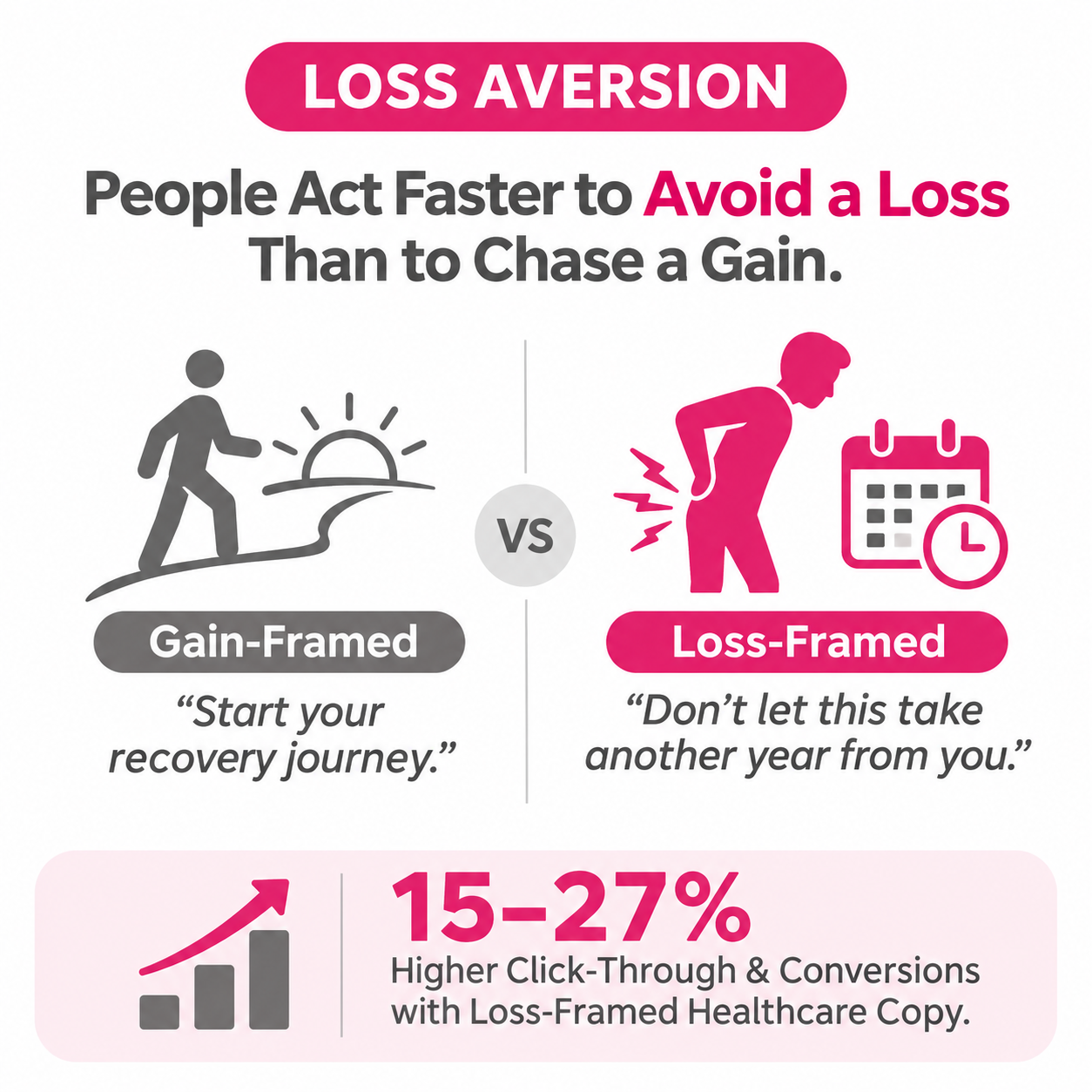
First documented by Kahneman and Tversky in 1979, loss aversion is the principle that losses feel roughly twice as painful as equivalent gains feel rewarding. In healthcare, this asymmetry is the dominant force.
Patients do not seek treatment because they are excited about a healthier future. They seek treatment because something they value — their relationship, their career, their physical function — is under threat.
Loss-framed healthcare ad copy consistently outperforms gain-framed copy by 15–27% in click-through and conversion testing. The shift is subtle but powerful: from ‘start your recovery journey’ to ‘stop losing ground to this.’ From ‘find your path to wellness’ to ‘don’t let this take another year from you.’
 Lever 2: Authority and social proof
In healthcare, social proof works differently than in most other industries.
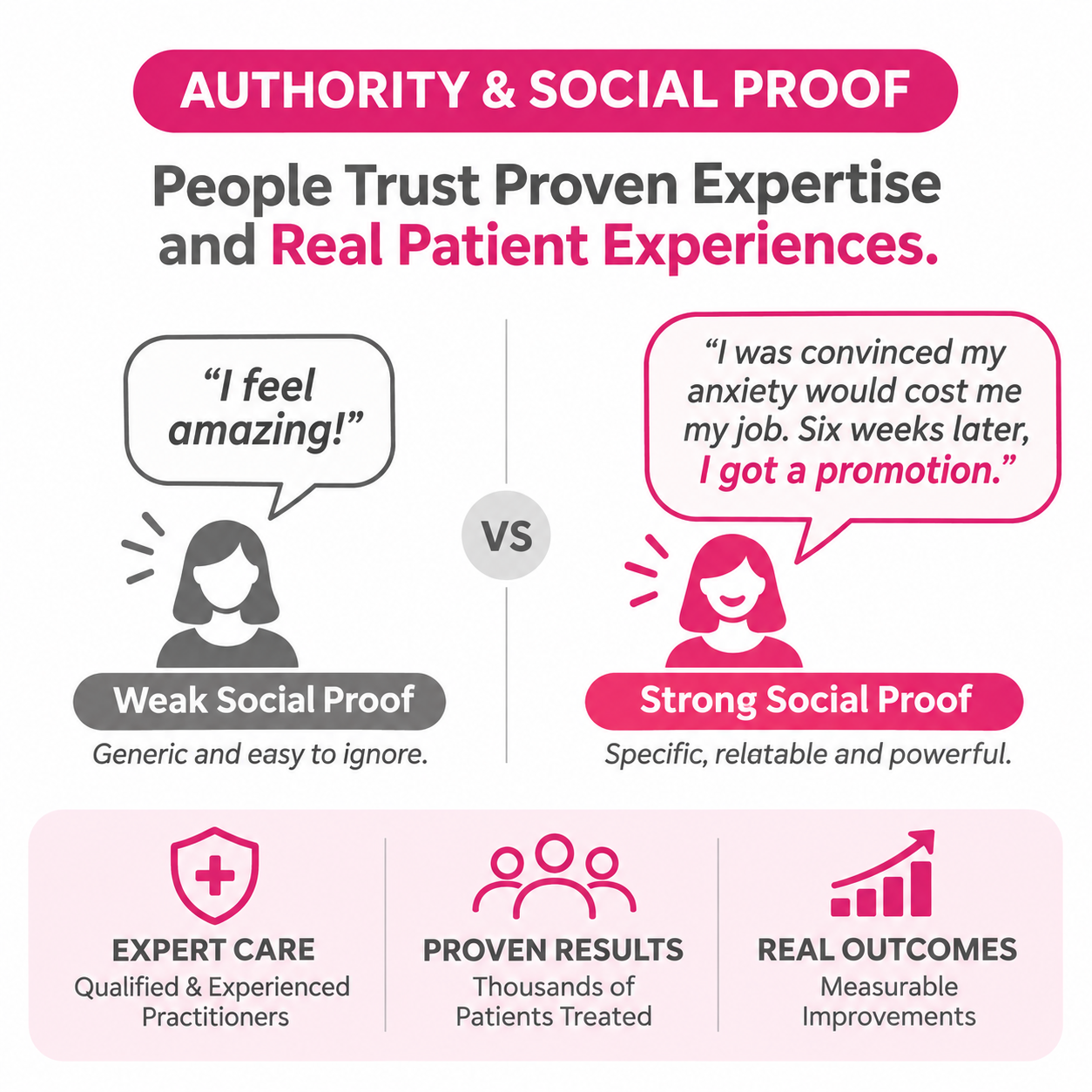
A testimonial saying ‘I feel amazing!’ is weak.
A testimonial that names the specific fear that was resolved — ‘I was convinced my anxiety would cost me my job. Six weeks later, I got a promotion’ — is powerful.
It speaks directly to the loss the next patient is afraid of experiencing.
Most clinics bury their strongest authority signals — clinical outcomes, practitioner credentials, patient volumes, specific results — on an About page nobody reads. These signals need to be in the ad, above the fold on the landing page, and present at every point where a patient could hesitate.
 Lever 3: Cognitive load reduction
Anxious buyers abandon complex decisions.
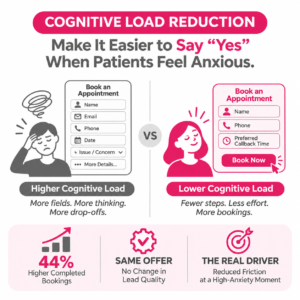
Every extra step in your booking flow, every jargon-heavy line in your ad copy, every form field that isn’t strictly necessary — each one adds cognitive load at the worst possible moment in your patient’s decision process.
One private mental health clinic reduced their intake form from eight fields to three (name, phone, preferred callback time) and saw a 44% increase in completed bookings with no change in lead quality.
The offer was identical. The only change was the reduction of friction at the moment of highest anxiety. Cognitive load reduction is not a design problem — it is a behavioral problem with a behavioral solution.
 Lever 4: Nudge theory in patient booking flows
Nudge theory, developed by Thaler and Sunstein, shows that small architectural changes in how choices are presented dramatically affect which choices people make — without removing any options.
In a healthcare context, nudges operate at every touchpoint:
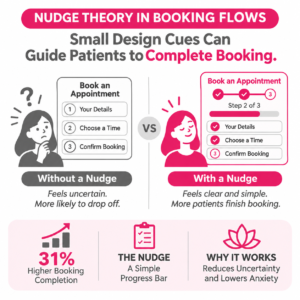
the default option on a booking form, the progress indicator showing ‘2 of 3 steps complete,’ the confirmation message after a booking that reinforces the decision rather than reopening it.
A physiotherapy brand added a single progress bar to their three-step booking flow. Booking completion increased by 31%. Nothing else changed. The nudge reduced the anxiety of the unknown — patients could see they were almost done, which made finishing feel easier than stopping.
 Lever 5: Commitment and consistency
Cialdini’s commitment principle establishes that once someone takes a small first step, they are significantly more likely to follow through with a larger one.
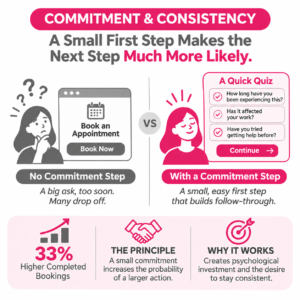
In healthcare marketing, this means engineering micro-commitments into your funnel before you ask for the booking.
A mental health platform introduced a three-question quiz — ‘How long have you been experiencing this?’ / ‘Has it affected your work?’ / ‘Have you tried getting help before?’ — before the booking page.
Completed bookings increased by 33%. The quiz-taker felt partially committed before they even saw the calendar. The step from quiz to booking felt smaller than the step from cold landing page to booking because it was. Commitment and consistency made it so.
What Behavioral Research Reveals That Analytics Can’t
Analytics tells you what happened. A 72% bounce rate on your service page. An average session duration of 38 seconds. A mobile conversion rate 60% lower than desktop. These numbers confirm that something is wrong. They cannot tell you why.
Behavioral research fills that gap. Consider a healthcare brand with high mobile ad click-through but a persistently low booking rate. Analytics suggested a mobile UX problem.
Behavioral research revealed something different: the ad used urgency language that activated loss aversion — ‘don’t wait until it gets worse’ — and the landing page responded with calm, aspirational copy — ‘your journey to wellness starts here.’
The emotional continuity was broken at the exact moment it mattered most. The patient felt a sense of alarm from the ad, arrived at a page that dismissed that alarm, and left. No amount of mobile UX optimisation would have fixed that. The analytics would never have found it.
What behavioral research actually involves in a healthcare context
Behavioral marketing research is not a survey or a focus group. It is a structured analysis of the psychological gap between what your marketing is saying and what your patient is ready to hear. In practice this involves:
- Competitor messaging analysis through a psychological lens — not what competitors say, but which emotional triggers they are activating and which they are ignoring
- Patient language audits — mapping the exact words patients use when searching for help versus the clinical language clinics use in their ads. The gap between these two vocabularies is often where conversion is being lost.
- Trigger mapping — identifying which specific fears and assets are most psychologically activating for your particular audience, and in what sequence they need to be addressed
- Funnel continuity assessment — ensuring the emotional tone established in the ad is maintained through the landing page, booking flow, and confirmation sequence
The output of this research is not a report full of graphs. It is a behavioral brief — a clear picture of how your specific patient thinks, what they fear, what moves them, and what language they are ready to respond to. Every campaign that follows is built on that brief.
Applying the Playbook: What Changes Across Your Marketing Stack
Behavioral marketing is not a new channel or a new type of content. It is a new lens applied to the marketing you are already running. Here is what changes across each touchpoint when that lens is applied.
Ad copy — Meta and Google
The single most impactful change in most healthcare ad accounts is shifting from gain-framing to loss-framing in headline copy. This does not mean making ads feel negative or fear-based — it means being accurate about where your patient is emotionally right now.
| Gain Framed – Current Copy | Loss-Framed Behavioral Copywriting |
|---|---|
| “Start your healing journey today” | “Stop letting this hold you back. Help starts this week.” |
| “Reclaim your health and vitality” | “Don’t let one more year go by without addressing this.” |
| “Our compassionate team is here for you” | “Your family needs you present. Our team makes that possible.” |
The Ethical Foundation: Why Responsible Behavioral Marketing Works Better
Loss aversion and behavioral triggers work precisely because the stakes in healthcare are genuinely high. That power demands careful handling — and not just for ethical reasons. Responsible behavioral marketing is also, demonstrably, more effective.
They have seen manufactured urgency, false scarcity, and exploitative fear messaging too many times.
When behavioral triggers are applied to fears that are not real, or with intensity that is not warranted, trust collapses permanently. In an industry built on referrals and patient relationships, that collapse is catastrophic.
The practical test for every piece of healthcare copy is straightforward: would a licensed clinician be comfortable saying this to a patient in their office?
If the answer is no, rewrite it. Marketing and clinical teams should review ad copy together — not because this is an ethical formality, but because clinicians understand the patient’s emotional state in ways that marketers often don’t, and that understanding produces better conversion alongside better care.
Behavioral marketing that respects the patient’s intelligence and emotional state doesn’t just convert better — it converts the right patients, who stay, refer, and trust. That compounding effect is worth far more than any short-term lift from manipulative tactics.
The Final Thought
Healthcare marketing is not failing because of budget constraints, platform algorithm changes, or a shortage of creative ideas. It is failing because it is speaking a language — aspirational, gain-framed, emotionally disconnected — that the patient is not ready to receive at the moment they encounter it.
The five behavioral levers in this playbook — loss aversion, authority and social proof, cognitive load reduction, nudge theory, and commitment and consistency — do not require a bigger budget or a different channel. They require a different understanding of how your patient thinks at the moment of decision.
When your ads acknowledge the fear your patient is actually feeling, when your landing page continues that emotional conversation with trust and reassurance, when your booking flow removes friction at the exact moment anxiety peaks, and when your follow-up reinforces the decision rather than reopening it — the entire funnel changes. Not because you reached more people. Because you finally reached the part of them that makes decisions.
Behavioral marketing in healthcare isn’t a new channel or a new budget line. It’s a new lens — on the ads you’re already running, the pages you already have, and the patients who are already looking for you.
Understanding which behavioral levers apply to your specific audience, and how to activate them ethically across your funnel, is the work of behavioral marketing research. If you want to see how this playbook applies to your specific healthcare brand, that is exactly what we do at Market to Mind.
About the Author: Jawahar Kaushal