Your healthcare ads are not being ignored because people don’t care.
They are being ignored because four specific cognitive biases are working inside your patient’s mind — quietly, consistently, and invisibly — to justify doing nothing.
Definition of Bias: It is a way of thinking that can influence our judgement.
These are not biases you can overcome with a bigger budget, a better creative, or a stronger offer. They operate below the level of conscious decision-making. And until your marketing is designed to neutralise them, they will keep winning.
Most healthcare marketing is built around the assumption that patients are ready to act — that they just need the right message to tip them over the edge. This is the wrong assumption.
The majority of people who see your ad are not undecided between you and a competitor. They are undecided between acting and not acting at all. That is a fundamentally different problem. And it requires a fundamentally different solution.
The four biases in this article are the primary forces keeping your patients in a state of inaction. Understanding them changes how you write your ads, how you structure your landing page, and how you frame your calls to action.
Not because you are manipulating anyone — but because you are finally addressing what is actually happening in the mind of the person you are trying to reach.
Why Standard Healthcare Ads Don’t Reach the Part of the Brain That Decides
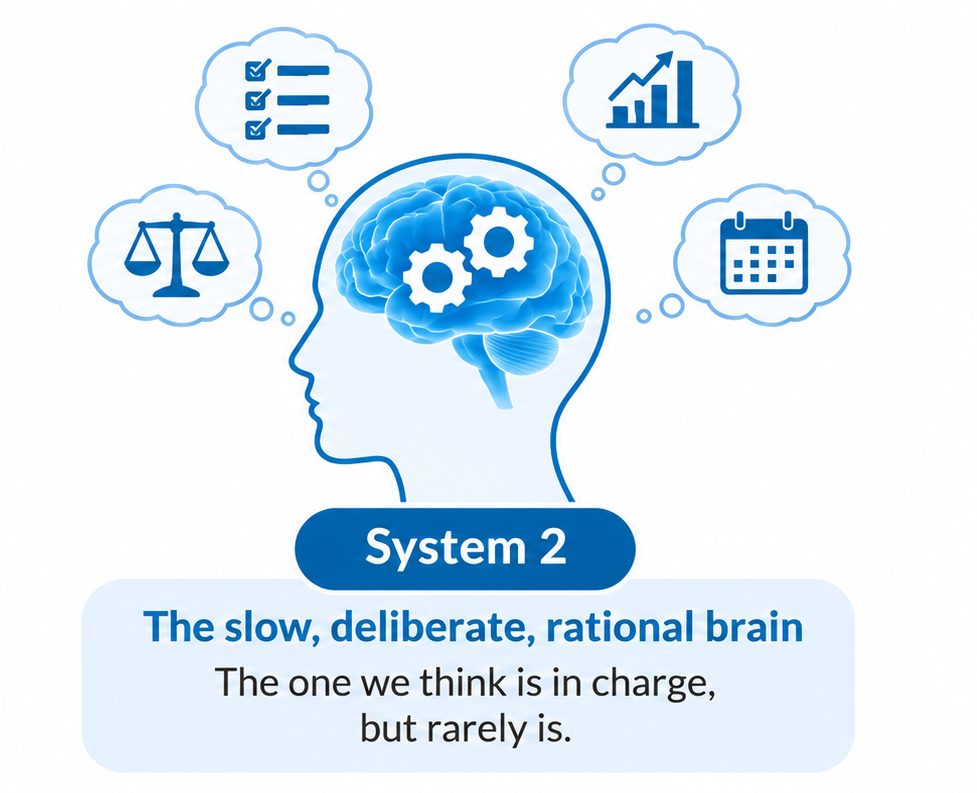
Daniel Kahneman’s framework of System 1 and System 2 thinking is essential context for everything that follows.
Healthcare decisions are almost always initiated by System 1.
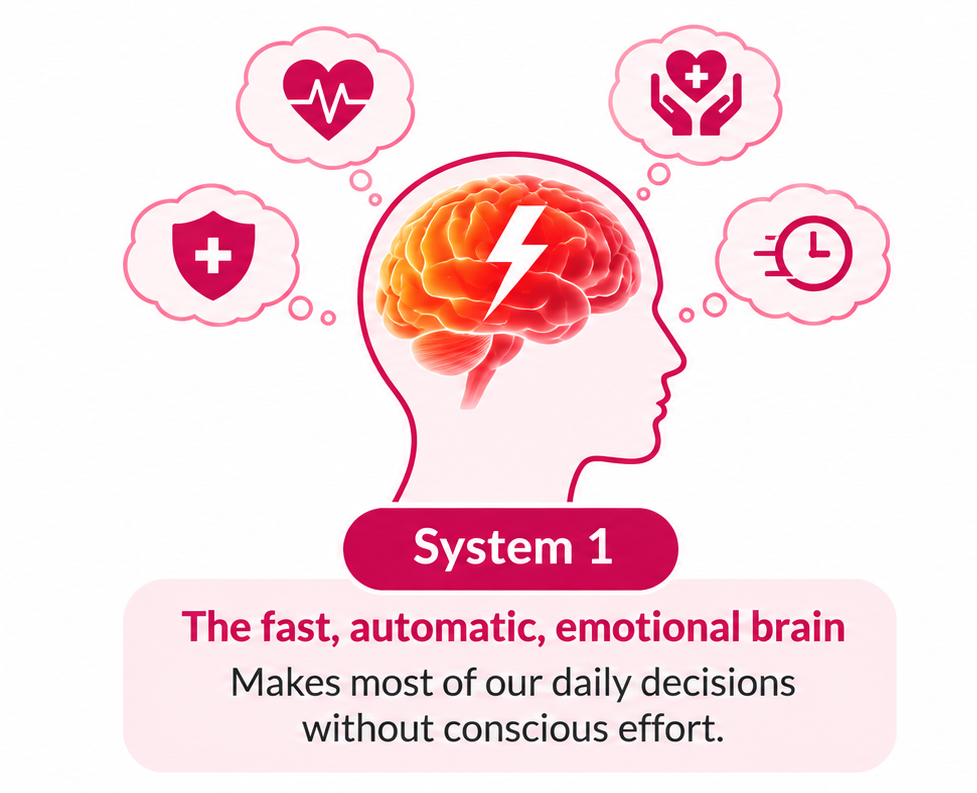
A patient notices a symptom, feels a fear, experiences a moment of concern. That is System 1.
But then something happens: System 2 kicks in and provides rational cover for inaction.— ‘It’s probably nothing.’ ‘I’ll wait and see.’ ‘I don’t have time this week.’ These are System 2 rationalisations — logical-sounding reasons that allow the patient to avoid the anxiety of acting.
Most healthcare ads speak to System 2.
They present information, credentials, and benefits. They assume the patient is rationally evaluating options. Meanwhile System 1 — the part that actually initiates action — is being held hostage by four specific cognitive biases that your ad is not addressing at all.
Your healthcare ad is competing with inertia, not with other clinics. The patient who doesn’t book is not choosing a competitor. They are choosing to do nothing. These four biases explain why — and how to change it.
The Four Biases Keeping Your Patients in Inaction
Bias 1: Status Quo Bias
Easy Meaning: The tendency to prefer the current state of affairs — even when change would clearly be beneficial
Status quo bias is neutralised by making the cost of staying the same feel larger than the cost of changing.
Your ad needs to name what the patient is losing by doing nothing — not what they will gain by acting. Instead of ‘get back to living pain-free,’ try ‘every week without treatment is another week your back decides what you can and can’t do.’
The status quo stops feeling like safety and starts feeling like a choice they are actively making against their own interests.
Bias 2: Optimism Bias
Easy Meaning: The belief that bad outcomes are less likely to happen to us than to other people
Optimism bias is neutralised by specificity and personalisation.
Generic statistics activate optimism bias — the patient mentally excludes themselves.
Specific, relatable scenarios activate recognition instead. Instead of ‘millions suffer from untreated anxiety,’ try ‘if you have cancelled plans in the last month because you felt overwhelmed, your anxiety is already making decisions for you.’ The patient cannot exclude themselves from a scenario they have already lived.
Bias 3: Confirmation Bias
Easy Meaning: The tendency to search for and interpret information in a way that confirms existing beliefs
Confirmation bias can be overcome by entering the conversation they are already having with themselves. Your ad should name the exact reassurance they are telling themselves — and then gently challenge it.
Confirmation bias cannot be overcome by providing better information — the patient will reject information that contradicts their existing belief.
‘If you have Googled your symptoms and decided it is probably nothing — that is exactly what everyone thinks before it becomes something.’
This technique is called mirroring — you reflect their current thought back at them, which creates enough cognitive dissonance to open the door to a different interpretation.
Bias 4: Hyperbolic Discounting
Easy Meaning: The tendency to prefer smaller rewards now over larger rewards later — and to delay costs that feel distant.
Hyperbolic discounting is neutralised by collapsing the time horizon.
Make the cost of waiting feel immediate — not distant. And make the first step feel trivially easy so the present-moment friction disappears.
‘The 60 seconds it takes to book this call is the only hard part. Everything after that is us taking care of you.’
You have made the present-moment cost (60 seconds) feel smaller than the future cost of not acting. You have also made the future feel closer — because there is a concrete next step with a defined time cost.
How These Four Biases Stack — Why Some Patients Never Book at All
In isolation, each of these biases creates friction. In combination, they create a wall.
Consider a patient experiencing early symptoms of anxiety.
Status quo bias tells them their current level of discomfort is manageable — change feels riskier than staying.
Optimism bias tells them it is probably temporary and they are not the kind of person who needs professional help.
Confirmation bias leads them to Google reassuring explanations and ignore the concerning ones.
Hyperbolic discounting means that even when they do feel motivated to book, the immediate friction of making an appointment wins over the abstract future benefit of feeling better.
Your ad — however well-written — is landing in the middle of this psychological environment. This is why a patient can see your ad five times, think ‘I should really look into that,’ and never click. Not because your ad is bad. Because the biases are strong.
Putting It Together: Ad Copy That Addresses All Four
Here is what a standard healthcare ad looks like, followed by a rewrite that addresses all four biases in sequence:
| Standard Ad – Ignores all 4 biases | Behavioral Rewrite – Neutralises all 4 biases |
|---|---|
| Headline: “Struggling with anxiety? | Addresses status quo bias: “If you have Googled your anxiety symptoms and decided you are probably fine — that is what most people think until it starts costing them something.” |
| Sub-Headline: “Our compassionate team can help you find your path to wellness.” | Addresses optimism + confirmation bias: “If it has affected one relationship, one opportunity, or one night of sleep in the last month — it is already making decisions for you.” |
| Body: “We offer evidence-based anxiety treatment in a warm, supportive environment. Our experienced clinicians are here to help you reclaim your wellbeing. Book a consultation today.” | Addresses hyperbolic discounting: “A 15-minute call is all it takes to know if we can help. Book one now — it costs you nothing and it tells you everything.” |
| What the patient does: Thinks ‘that’s nice’ and keeps scrolling. All four biases remain intact. | What the patient does: Recognises themselves. Feels seen. The friction of booking has shrunk. They click. |
The Final Thought
Your healthcare patients are not indifferent. They are not choosing a competitor. They are caught in a web of cognitive biases that make inaction feel safer, more rational, and more comfortable than acting — even when acting is clearly in their best interest.
Status quo bias tells them that staying the same is safer than changing. Optimism bias tells them the problem will probably resolve itself. Confirmation bias helps them find reasons to believe that. And hyperbolic discounting makes next week feel like a perfectly reasonable time to deal with it.
None of these biases respond to more information, better credentials, or a more compassionate tone. They respond to being addressed directly — to copy that names the cost of inaction, uses specific scenarios rather than general statistics, mirrors the patient’s internal dialogue, and makes the first step feel trivially easy.
The patient who books is not the one who saw the best ad.
They are the one whose ad spoke directly to what was keeping them from acting. That is the difference between healthcare marketing that informs and healthcare marketing that converts.
Understanding which biases are most active for your specific patient audience — and how to neutralise each one in your ad copy, landing page, and booking flow — is the core of what the behavioral marketing playbook for healthcare covers.
If you want this analysis applied specifically to your clinic or wellness brand, the Behavioral Campaign Blueprint is where that work begins.
About the Author: Jawahar Kaushal